From muddy boots to maritime captain
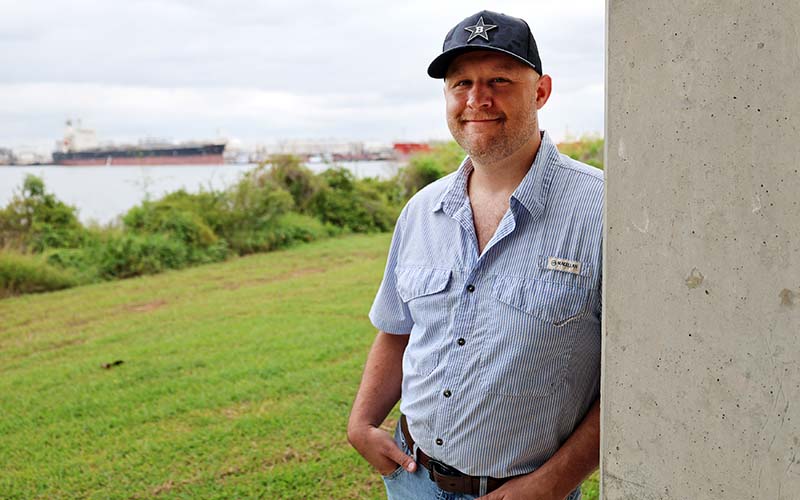
With its pristine drywall and gleaming floors, San Jacinto College’s new Maritime Campus seemed an odd place for a student to clomp around in muddy boots.
Far from careless, though, Warren Buhrman was committed to his maritime studies — coming straight from digging ditches to plotting charts and throwing lines.
“My company allowed me to take a break for classes, then come back to work afterward,” he said.
Clean shoes eventually replaced work boots, but nothing could replace Buhrman’s passion for his new career goal.
Fishing for the right career
Buhrman grew up fishing around Galveston Bay, watching tugboats glide past as his line dangled in the water.
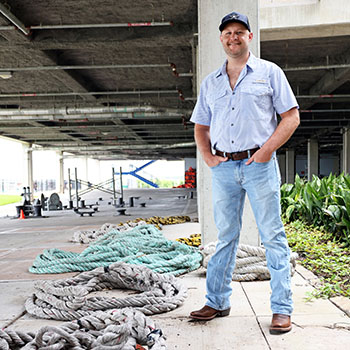
In 2015, an ad about San Jac’s new maritime program piqued his interest. Buhrman researched the industry, then met with Amy Arrowood,
maritime credit program director. After taking one introductory maritime class, he
was all in.
“That little ad in the Houston Chronicle changed my life,” he said. “I was bouncing around between my major and working a trade with demolition construction and plumbing. I didn’t have a clear path on what I wanted to do.”
When he charted his path, he stayed the course.
“It took me a while, but I did it,” he said.
Learning the ropes
Buhrman started the maritime program at its temporary site off State Highway 225. Students at that time, he remembers, were “packed like sardines” in makeshift classrooms. When the new campus opened in fall 2016, they switched to spacious classrooms overlooking the Ship Channel and high-tech simulators.

Not only did Buhrman appreciate the personable professors and student camaraderie,
but he also found the classes intriguing. He learned chart plotting, survival, safety,
and even firefighting while earning his Coast Guard certifications.
“Not everyone can say they put on a fire suit and ran into a burning building during college,” he said.
For his three-month summer internships, he served as a deckhand with Buffalo Marine, a company that fuels ships coming in and out of the Ship Channel.
While interning on a “floating gas station,” he chipped rust, painted, cleaned, and tied off barges — the grunt work every mariner starts with.
Right before Buhrman graduated, he landed a full-time job at Buffalo Marine. In fact, while fellow graduates were tossing their caps at commencement, he was already on the water.
Casting off
After a stint as deckhand, Buhrman got promoted to tankerman. From there, he transitioned to pilot, then relief captain. This year, he became the lead captain of the motor vessel San Brendan.
Maritime is so important in this economy, the way the world is turning. If the maritime industry stopped, the world would stop.
In this role, he ensures the safety of his five-person crew and organizes the day’s tasks. He has also sharpened his management skills — learning to be fair with everyone and respecting others’ backgrounds and beliefs.
“People will work hard for you if you can understand where they’re coming from first,” he said.
Living aboard the vessel two weeks on, one week off, Buhrman and his crew travel the Intracoastal Waterway from Lake Charles to Freeport.
“You get to see things other people don’t see — the way the world turns in the oil and gas industry,” he said. “It can be challenging and dangerous, but sometimes it can be absolutely beautiful.”
Navigating the future
Working in a field that’s “365, 24/7,” Buhrman eventually sees himself as a portside administrator, though “not anytime soon.”
“That’s the end goal — portside work,” he said. “A lot of captains become port captains because you go home every day.”
Advice he’d give to prospective mariners? Talk to the Maritime Campus staff.
“Do your research first,” he said. “There are so many routes you can take in the maritime industry. Ask about the program, what it offers, and how it correlates to different careers.”
What is certain is the industry offers job security.
“Maritime is so important in this economy, the way the world is turning,” Buhrman said. “If the maritime industry stopped, the world would stop.”
Learn more about the maritime program
Take the Plunge
Learn from the best
Leave the classroom
Earn solid wages
Sailors and marine oilers earn around $56,000, while captains, mates, and pilots earn around $119,000 (texaswages.com).
About San Jacinto College
Surrounded by monuments of history, evolving industries, maritime enterprises of today,
and the space age of tomorrow, San Jacinto College has served the people of East Harris
County, Texas, since 1961. The College is ranked second in the nation among more than
1,100 community colleges, as designated by the Aspen Institute and was named an Achieving
the Dream Leader College of Distinction in 2020 and 2026. As a Hispanic-Serving Institution
that spans five campuses, plus an online college, San Jacinto College serves approximately
45,000 credit and non-credit students annually. It offers more than 200 degrees and
certificates across eight major areas of study that put students on a path to transfer
to four-year institutions or enter the workforce. The College is fiscally sound, holding
bond ratings of AA+ by Standard & Poor’s and Aa2 by Moody’s. San Jacinto College is
accredited by the The Commission on Colleges and Universities.